Contents
The Evolution of Value: Why Refrigerant Choice is Now a Strategic Asset
For decades, the HVAC industry evaluated “quality” through the lens of mechanical reliability and energy efficiency. Today, a third pillar has emerged that is arguably more influential in the B2B sector: the environmental lifecycle of the refrigerant. Navigating a successful low-gwp refrigerant transition is no longer a localized European or American phenomenon; it is the new global standard for export excellence. For international distributors and agents, this mandatory low-gwp refrigerant transition is no longer a technical footnote in a product catalog—it is a strategic asset that determines the longevity and resale value of their entire inventory.
At Kanion Co, we have observed that the most successful global players are moving away from a reactive compliance model toward a proactive “Portfolio Synchronicity” approach. By aligning product development with the EPA AIM Act Technology Transitions in the U.S. and the Regulation (EU) 2024/573 in Europe, brands can ensure that their hardware remains relevant long after it has crossed international borders.
The Ripple Effect: Beyond the Gas in the Lines
The true complexity of the low-GWP refrigerant transition lies in its ripple effect across the entire business ecosystem. It is a common misconception that this shift only affects the engineering department. In reality, the transition necessitates a fundamental redesign of the brand’s relationship with its supply chain, its service network, and its end-users.
When we talk about the low-GWP refrigerant transition, we are talking about a systemic upgrade. This includes everything from the chemical stability of new blends to the flammability safety protocols required for residential installations. As global cooling demand continues to surge—a trend highlighted by the International Energy Agency (IEA)—the industry must solve the “Cooling Paradox”: providing more comfort while significantly reducing the global warming impact of the systems themselves.
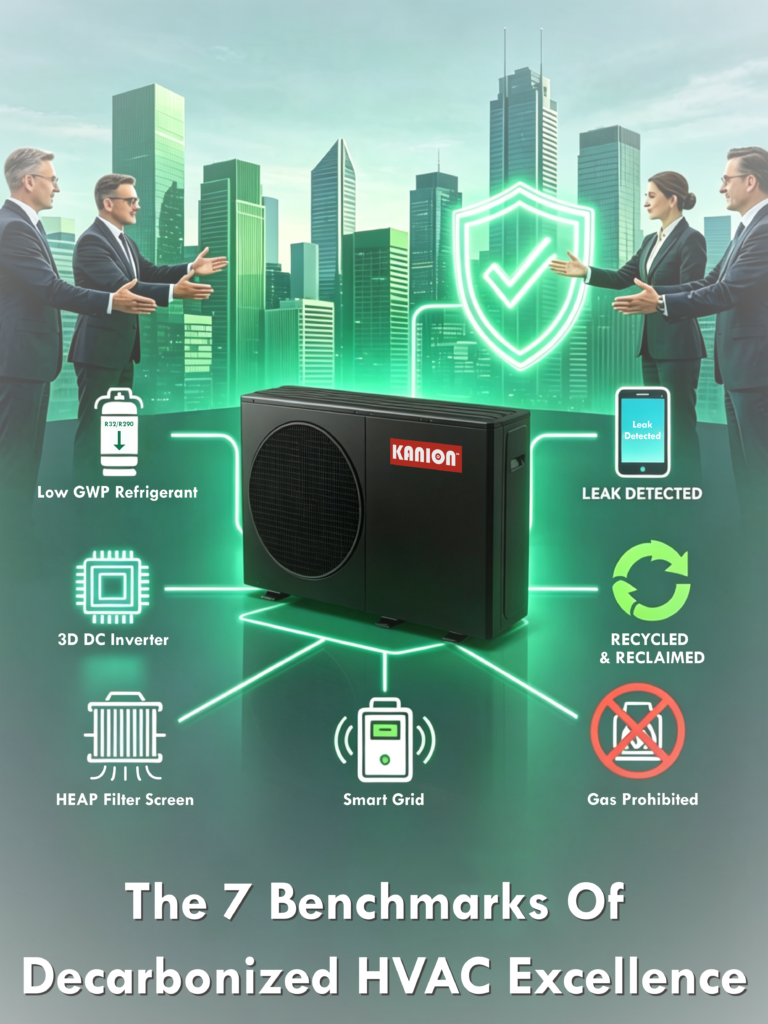
7 Strategic Shifts Reshaping the HVAC Global Portfolio
1. The Transition from Global to “Regional-Specific” Engineering
The era of the “Universal Outdoor Unit” is fading. The low-GWP refrigerant transition has forced a shift toward localized engineering. For example, a system optimized for R32 in a high-ambient temperature market may require completely different compressor tuning and safety sensors than a system designed for R290 or R454B in a temperate zone. This regionalization requires a more sophisticated product management team that can navigate the nuances of local codes and standards.
2. Certification as a Market Entry Bottleneck
One of the most significant risks in the modern HVAC trade is “Certification Lag.” As the industry moves toward lower-GWP alternatives, the laboratories responsible for safety and performance testing are experiencing unprecedented backlogs. Brands that treat certification as a last-minute task will find themselves locked out of key markets. Proactive planning is now the only way to guarantee a continuous supply of compliant equipment.
3. The Digitalization of the Refrigerant Lifecycle
In the new regulatory landscape, every gram of refrigerant must be accounted for. Managing a complex low-gwp refrigerant transition is inextricably linked with digital reporting. From the F-gas Portal in the EU to the tracking requirements of the AIM Act, the ability to provide real-time data on refrigerant flows is now a prerequisite for trade. As global cooling demand continues to surge—a trend highlighted by the International Energy Agency (IEA)—this “Data-First” approach is what separates premium HVAC brands from budget manufacturers.
4. Redefining Installation as a “Skill-Based” Sale
The shift to mildly flammable (A2L) refrigerants has fundamentally changed the human element of the industry. Installation readiness is no longer just about having a set of gauges; it’s about having a certified skill set. At Kanion Co, we empower our partners by providing the technical logic and safety documentation needed to bridge this skills gap, ensuring that the low-GWP refrigerant transition does not stall at the installation site.
5. After-Sales Operations as a Compliance Shield
Leak prevention is now a legal mandate in many jurisdictions. This means that a brand’s after-sales service quality is now a direct reflection of its compliance standing. Maintenance contracts are evolving into “Compliance Agreements,” where the focus is on lifecycle management, professional recovery, and zero-leak integrity.
6. The Logistic Complexity of Dual-Track Inventories
Managing the transition means managing two parallel supply chains. For a significant period, distributors must maintain spare parts and support for legacy R410A systems while simultaneously scaling their inventory of R32 or R454B units. This “Dual-Track” logistics strategy requires a higher level of capital efficiency and warehouse management.
7. Phased Portfolios: The Art of Timing the Market
Success in the low-GWP refrigerant transition is often a matter of timing. Moving too early can lead to high costs and lack of installer readiness; moving too late leads to regulatory exclusion. The strongest export strategies are those that phase their transition by product category, starting with high-volume residential splits and gradually moving toward larger commercial applied systems as the infrastructure matures.
Masterclass FAQ: Mastering the Low-GWP Transition
Q1: Why is R32 often chosen over R454B in certain markets?
A1: R32 is a single-component refrigerant, meaning it has zero temperature glide and is easier for technicians to handle and recycle. R454B, while having a lower GWP, is a blend that requires more precise charging techniques (liquid phase) and specific toolsets.
Q2: How does the AIM Act’s phasedown schedule impact long-term planning?
A2: The AIM Act sets a clear, declining path for HFC production. This means that the cost of legacy refrigerants will continue to rise, making the low-GWP refrigerant transition an economic necessity for maintaining competitive operational costs.
Q3: Are low-GWP refrigerants compatible with existing piping?
A3: Generally, no. Most low-GWP transitions (like the shift to A2L) require specific components, oils, and safety sensors. Reusing old piping without a thorough system redesign and cleaning can lead to premature compressor failure and safety risks.
Q4: What is “Lifecycle Responsibility” in the context of HVAC?
A4: It is the obligation of the manufacturer and distributor to ensure that a unit’s environmental impact is minimized from the factory floor to the disposal site. This includes recovery programs and certified disposal of old gases.
Q5: How can K-Climate Hub help me explain these changes to my customers?
A5: The K-Climate Hub provides a centralized repository of “Knowledge Solutions.” We offer the white papers, technical datasheets, and regulatory explainers that allow you to act as a consultant to your end-users, rather than just a salesperson.
Q6: Does the transition improve the actual cooling performance of the AC?
A6: In many cases, yes. Lower-GWP refrigerants often have superior thermodynamic efficiency, allowing for smaller heat exchangers and lower energy consumption, which directly benefits the end-user’s utility bills.
Conclusion: Leading with Knowledge in a Changing Climate
The low-GWP refrigerant transition is the most significant opportunity for professional growth the HVAC industry has seen in decades. It forces us to elevate our standards, invest in our people, and rethink our impact on the planet. At Kanion Co, we are not just following the trend; we are engineering the future. By embracing these 7 strategic shifts, we are ensuring that our partners are not just “compliant,” but are the undisputed leaders in their respective markets.
Ready to future-proof your HVAC portfolio? Contact us for a consultation on how to align your next shipment with the global 2026 standards.