Contents
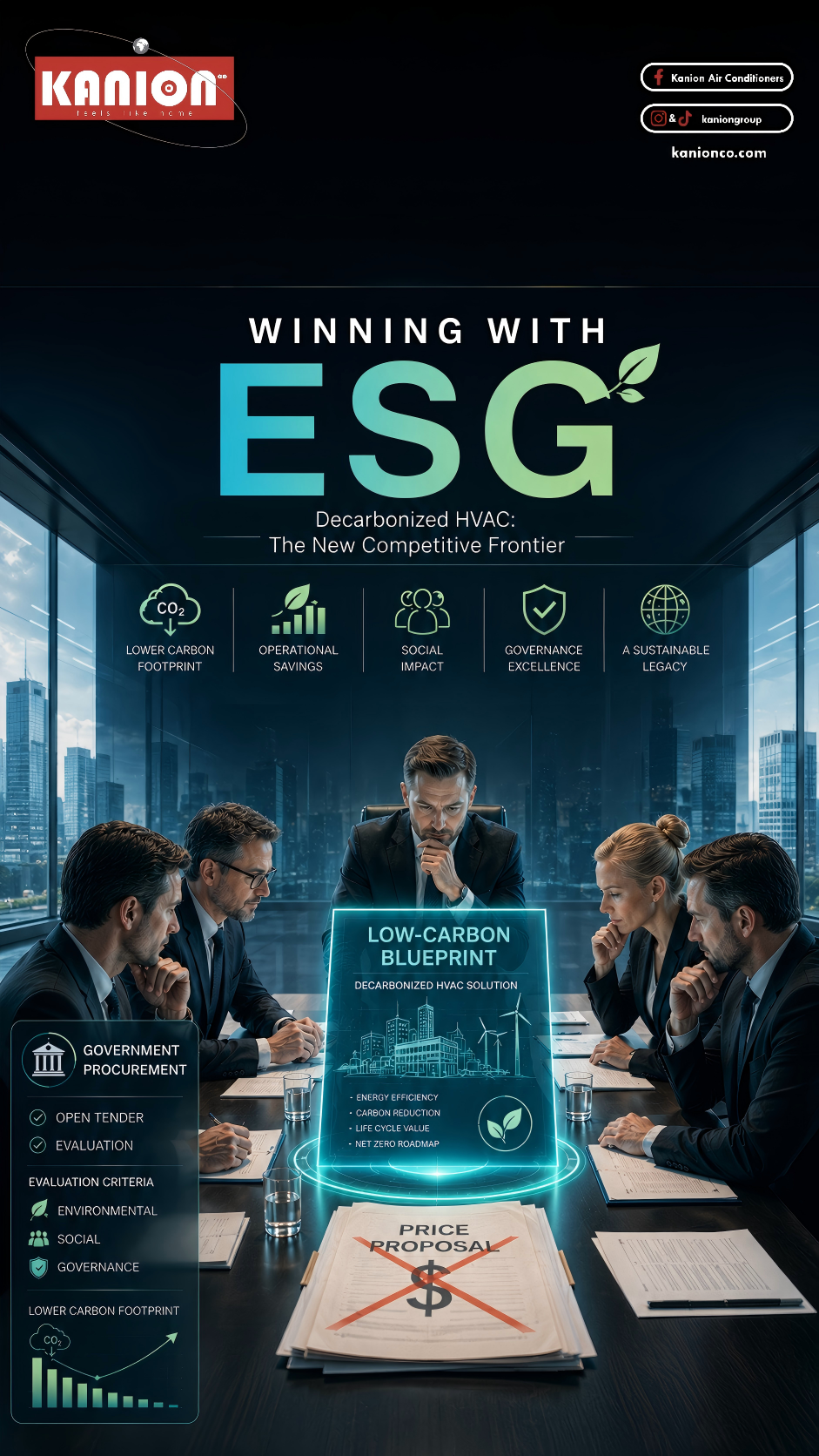
The New Competitive Frontier: Why Tenders are Moving Beyond Price
In the high-stakes arena of global infrastructure and commercial development, the criteria for winning a contract have undergone a radical transformation. As we move through 2026, the lowest bid is no longer the guaranteed winner. Instead, government procurement officers and institutional developers are prioritizing the decarbonization blueprint of proposed mechanical systems. For any firm aiming to secure the next generation of government and commercial tenders, the HVAC system has evolved from a utility cost into a strategic differentiator.
The reason for this shift is clear: net-zero mandates are now legally binding for public sector projects in major economies. Whether it is a new administrative complex in Europe or a healthcare facility in the United States, the alignment with commercial HVAC ESG standards is a prerequisite for eligibility. At Kanion Co, we have observed that the winners of tomorrow’s tenders are those who can demonstrate a superior “Compliance IQ” by meeting the following seven benchmarks.
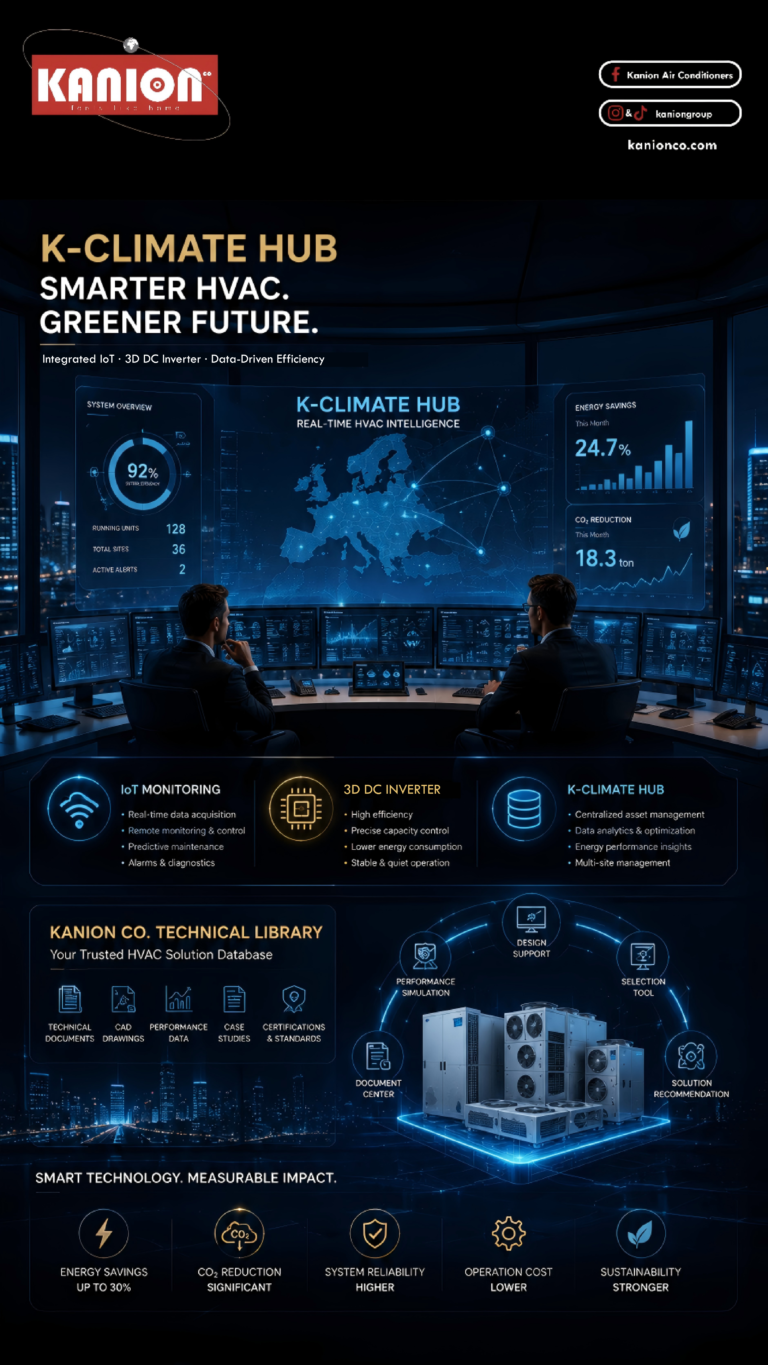
The 7 Benchmarks of Decarbonized HVAC Excellence
1. Absolute GWP Thresholds for Refrigerant Selection
The first benchmark in modern government and commercial tenders is a strict limit on Global Warming Potential (GWP). Under the EPA AIM Act and Regulation (EU) 2024/573, any HVAC proposal using legacy high-GWP refrigerants like R410A is often disqualified at the screening stage. Tenders now demand systems that utilize next-generation alternatives—such as R32 or R290—which offer a significantly lower environmental footprint without compromising on thermodynamic efficiency.
2. Verified SEER and SCOP Performance at Partial Loads
Energy efficiency is the second pillar of the decarbonization blueprint. However, 2026 tenders are looking beyond peak performance. They are demanding data on how systems perform at partial loads, where commercial units spend 90% of their operational life. Green building HVAC solutions that feature advanced full-DC inverter technology provide the energy savings necessary to meet the stringent Scope 2 emission targets set by institutional landlords and government bodies.
3. Real-Time Emissions Monitoring and Leak Detection
A major part of commercial HVAC ESG is the “G” for Governance. Modern tenders often require that mechanical systems include integrated, IoT-enabled leak detection. This digital transparency ensures that any refrigerant loss is identified and mitigated instantly, preventing the massive GWP impact of undetected leaks. At Kanion Co, we integrate these smart sensors to help our partners provide the “proof of performance” that auditors require.
4. Lifecycle Circularity: The Cradle-to-Grave Strategy
Government contracts are increasingly focused on the circular economy. This benchmark evaluates the manufacturer’s commitment to the entire product lifecycle—from the use of recycled materials in production to the provision of a clear recovery and reclamation plan for refrigerants. As highlighted by the International Energy Agency (IEA), minimizing the lifecycle impact of cooling is essential for future-proofing real estate.
5. Indoor Environmental Quality (IEQ) and Social Responsibility
The “S” in ESG is addressed through this benchmark. High-value tenders for schools, hospitals, and offices now mandate superior air filtration and humidity control. A green building HVAC system must demonstrate its ability to protect human health through hospital-grade HEPA filters and precise ventilation controls, turning “clean air” into a measurable project benefit.
6. Grid-Interactive Flexibility and Smart Demand Response
In 2026, a building is expected to be a “good citizen” of the electrical grid. This means HVAC systems must be able to communicate with the utility provider to shed loads during peak demand. Systems that offer grid-interactive features are scoring significantly higher in sustainable development tenders, as they contribute to the overall stability of the decarbonized energy network.
7. Electrification and the Displacement of Fossil Fuels
The final, and perhaps most decisive, benchmark is the elimination of on-site combustion. The global decarbonization blueprint is moving toward full electrification. Tenders are increasingly favoring high-efficiency heat pump systems that can provide both heating and cooling, effectively retiring the need for gas-fired boilers and significantly reducing the building’s total carbon footprint.
Strategic FAQ: Winning the 2026 Tender Landscape
Q1: Is a “Decarbonization Blueprint” required for all government tenders now?
A1: In major markets like the EU, North America, and parts of Asia, yes. Most public sector procurement now includes a “Sustainability weighting” that accounts for 20-30% of the total score.
Q2: How does a Low-GWP HVAC system help in winning commercial tenders?
A2: Large corporate tenants have their own net-zero goals. By offering green building HVAC solutions, developers make their properties more attractive to high-tier tenants, which in turn makes the project more viable for investors.
Q3: What is the most common reason for HVAC disqualification in modern tenders?
A3: Failure to meet the updated GWP limits or lack of verified energy performance data. Using “Compliance Logic” from the start is the only way to avoid this.
Q4: Can IoT data from HVAC systems be used for ESG reporting?
A4: Absolutely. The real-time data provided by modern commercial HVAC ESG systems is the “Source of Truth” for annual sustainability reports, making it a vital asset for any commercial project.
Q5: How does the K-Climate Hub assist in preparing tender documents?
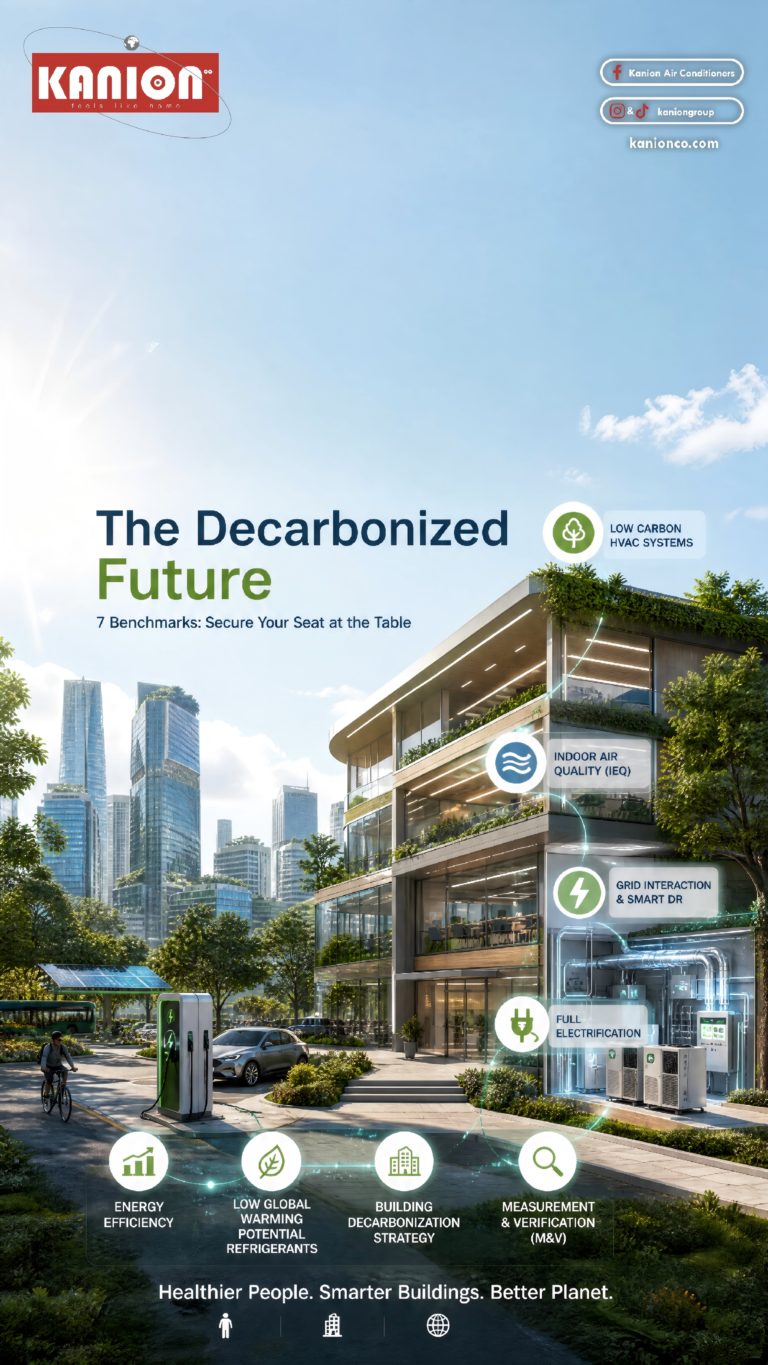
A5: The K-Climate Hub acts as your technical library. We provide the datasheets, certification files, and carbon-impact calculators that you need to include in your bid to prove your system’s decarbonization credentials.
Q6: Are heat pumps the preferred technology for net-zero buildings?
A6: Yes. Heat pumps are the cornerstone of the decarbonization blueprint because they allow for the total electrification of heating and cooling, which is essential for reaching net-zero.
Conclusion: Securing Your Seat at the Table
The landscape of government and commercial tenders has shifted. We are no longer just competing on technical specs; we are competing on the ability to deliver a sustainable future. By mastering these 7 Critical Benchmarks, your firm can move beyond the price wars and secure its position as a leader in the next generation of high-value projects.
At Kanion Co, we are dedicated to providing the green building HVAC technology that wins bids. We don’t just sell equipment; we provide the decarbonization blueprint that secures your project’s success in a rapidly evolving world.
Ready to win your next tender? Contact us for a technical consultation on aligning your bid with the 2026 decarbonization mandates.